So, at this point, I'm a week late for a new episode. Don't fear, a new one is coming. Probably next week. I recognize that I've skipped weeks before and haven't ever said why, except perhaps in passing. Normally, it's because I'm off performing my two weeks of annual training for the National Guard. But not this time.
It's like this. I need to get my life to a better place. Mainly with my health, but also my relationship with my wife and kids. I have high blood glucose and I need to get it under control. I've drastically altered my diet and am exercising more. That means earlier mornings, which require earlier nights. That means less time for recording and editing and everything else that goes into making the podcast.
If you're reading this, I assume you're a regular listener. For that I thank you. I owe you quite a bit. For example, I owe you more and better content. It's coming. Exactly what form that is, I don't know.
But back to my main point.
I'm exercising more, eating better, working harder on my Cub Scout commitments (I'm Cub Master for the Pack my son is in), working harder in my National Guard posting (Senior Platoon Trainer NCO for Officer Candidate School), and wanting to do more "hobby stuff." All of this takes time. Unfortunately, all of these things take a higher priority than simply banging out a podcast when it comes due.
Now, there is some cross-pollination in there. It's especially evident when it comes to my National Guard pursuits and my hobby. For example, Henry Hyde will be publishing an article I wrote as a direct result of my recent military education. Additionally, I'll be writing about my experience in planning a staff ride for the Officer Candidates. More on that later. Furthermore, I'm planning more articles for Henry.
As for the hobby stuff, I want to spend more time with my kids. Luckily, they both want to paint figures with me and play more games. Anticipate that generating more content for the podcast and maybe more blog posts here. For example, the projects I'm actively pursuing include:
- A semi-secret Seven-Years War project
- My son's 40k Orks
- A Full Thrust project using Halo ships
- A microarmor game I'm developing with my brother Chris
- Rommel in 3mm
- The Commands & Colors Epic Fantasy (not BattleLore) project (and I might have a writing partner for this one now)
- The space station project I talked about previously for sci-fi skirmish (possibly Oldhammerish)
Lots of other stuff is ruminating as well. What can I say, I'm a gaming magpie from way back. In the meantime, I'm trying to read more history, historical fiction, self-help, US Army doctrine publications and even the occasional hobby magazine!
I'm a busy guy. Part of this little pause has been taken up with some thought, soul searching, prioritizing, planning, and figuring what the hell I'm doing next. Part of that is going to take me becoming more personally disciplined in how I go about things. I've never scheduled "free time" before, but I might have to start.
We're all busy. So, I hope you can understand why I might be late with the podcast. I hope you'll forgive me. One of these days, you might even think what I produce was worth what you paid for it.
That is all.
Tuesday, 2 April 2019
Monday, 1 April 2019
Our Game Spaces Are A Reflection Of Us
CW/TW - brief mention of sexual assault issues.
Yea, this post is because of the revelations of abuse by former girlfriends Mandy, Vivka and Hannah of Zak Smith (Sabbath). If you haven't read them, go here and here.
This post is about privilege and the hue/cry I've seen about "Why does real life intrude on my game?!?"
That's because those two things have a lot in common, with these images:


None of these accusations were a surprise. I've kept my distance from Zak since Porngate/TARGA exploded in 2010. I've watched his toxic attitude and behaviors and they were huge red flags for me.
Talk to women in your family. Go ahead. Have that conversation about if things have happened. In fact, DON'T talk, just listen. It'll make you sick. Sex and power and how that has been used and abused is a thread that runs through our history and who we are.
There's another meme I want to share with you before I take a deep dive:


The world is changing. #metoo #blacklivesmatter #occupywallstreet As someone who likes to read to learn, I've been reading a lot about how life changed in the 60s. The kids, the hippies, the changing attitudes towards civil liberties, sex, the government and life in general. I'm pretty sure I would have been a hippie, but I digress...
We're living similar changes now, only we're on the other side as the older generation. Our kids and grandkids don't give a fuck about things the way we give a fuck. They are shaping the world, just as we shaped the world in our youth.
So what are we, the older generation going to do?
Adapt or die. But also put forth our values, the best ones, so that the DNA of those values carries on. Share the wisdom of experience and hard knocks and make it relevant so that the DNA carries on.
So what does this have to do with Princess Bride and the Buddha?
One of the refrains I'm seeing on reddit, on Twitter, on the forums, podcasts and blogs is this idea of "I'm sick of this (real life stuff and/or politics) coming into my games!"
Well, I believe that those things have always been in our games, swirling around us.
As youth, we either didn't give a shit, or we were on the side of games. For my generation, it was Satanic Panic over D&D. We didn't care, but I'm pretty sure that there was the grognardly grumbling over it from folks who didn't like seeing the 70s gonzo feel get altered by TSR as they adapted to the market and their audience.
So now the world is changing. Change is painful. It's constant. Both the Princess Bride and the Buddha say the same thing - life is about pain. But how we deal with that pain says much about us. Pain is mandatory. Suffering is optional.
I get the call of seeing games as a refuge. As a place where we can avoid the pain of life. But for me, as a white heterosexual cismale in the middle class, I shit, breathe and eat privilege. This is what I got in life. And it's been my observation, anecdotal as it may be, that the vast majority of those grumbling about politics and real world intruding on games have a healthy amount of privilege -- and they don't like the pain!
Well... how we react to pain, to life, to events like these is how we show the values and character of who we are.
I believe that fervently.
I get that some of us don't want our games to focus on inclusivity, on being thoughtful and considerate of our presentations of our worlds because it's.. .well... painful to change. To let go of the things that we've done/had/lived for 30, 40, 50 years.
Life is pain. Adapt or die.
I believe those things.
Look, I don't focus on the fact that I have tons of same-sex couples as NPCs. I present the fact as normal in my games and I move on. My minis are colored with many different racial colors because that's the way it is, without prejudice or show. I've had transfolks, gay folks, abuse survivors at my table and I've kept to these rules: Your fun doesn't overshadow someone else's fun and don't be an asshole at my table.
To me, this is just what it should be. Respect. Consideration. Awareness of the issues surrounding the people that come to my table.
Because people are affected by the world, just as they are affected by games. I would submit that there's a real truth that our RPG games are just as much of the story-telling, myth-relating tradition that we humans do with books, music, art, etc.. We might not be Plato, Chaucer, Shakespear at the table, but the things we do speak and reinforce things in our cultural DNA as much as the story of Gilgamesh does ... and there are threads that we all share!
I want my games to have the DNA of the values that I think are important. They are going to be political because we are political.
So these discussions are important. Because our niche of a niche has the same makeup as the real world.
There are abuse survivors.
There are abusers.
There are wonderful people, assholes, trans folks, homosexual, conservative, liberal folks and they bring the best/worst to the table. We are sharing space and sharing who we are.
So I get it, it sucks that real life intrudes. Life is pain. The kids don't give a shit if we don't like #metoo or we support it fully. This is the way the world is going.
Adapt or die. Because life is pain, princess. It doesn't mean it has to hurt.
PS. I enforce Laura Antoniou's "porch rule" - this blog is my front porch. I welcome discussion! I even want disagreement, tell me I'm wrong! But if you're going to spew hate, bullshit or just being a troll, I'm going to delete your comments.
You want "free speech" - then go protest against the government, which is what the Constitution of the United States guarantees to the citizens of the USA. Otherwise, my blog, my front porch, my rules.
Yea, this post is because of the revelations of abuse by former girlfriends Mandy, Vivka and Hannah of Zak Smith (Sabbath). If you haven't read them, go here and here.
This post is about privilege and the hue/cry I've seen about "Why does real life intrude on my game?!?"
That's because those two things have a lot in common, with these images:


None of these accusations were a surprise. I've kept my distance from Zak since Porngate/TARGA exploded in 2010. I've watched his toxic attitude and behaviors and they were huge red flags for me.
Talk to women in your family. Go ahead. Have that conversation about if things have happened. In fact, DON'T talk, just listen. It'll make you sick. Sex and power and how that has been used and abused is a thread that runs through our history and who we are.
There's another meme I want to share with you before I take a deep dive:


The world is changing. #metoo #blacklivesmatter #occupywallstreet As someone who likes to read to learn, I've been reading a lot about how life changed in the 60s. The kids, the hippies, the changing attitudes towards civil liberties, sex, the government and life in general. I'm pretty sure I would have been a hippie, but I digress...
We're living similar changes now, only we're on the other side as the older generation. Our kids and grandkids don't give a fuck about things the way we give a fuck. They are shaping the world, just as we shaped the world in our youth.
So what are we, the older generation going to do?
Adapt or die. But also put forth our values, the best ones, so that the DNA of those values carries on. Share the wisdom of experience and hard knocks and make it relevant so that the DNA carries on.
So what does this have to do with Princess Bride and the Buddha?
One of the refrains I'm seeing on reddit, on Twitter, on the forums, podcasts and blogs is this idea of "I'm sick of this (real life stuff and/or politics) coming into my games!"
Well, I believe that those things have always been in our games, swirling around us.
As youth, we either didn't give a shit, or we were on the side of games. For my generation, it was Satanic Panic over D&D. We didn't care, but I'm pretty sure that there was the grognardly grumbling over it from folks who didn't like seeing the 70s gonzo feel get altered by TSR as they adapted to the market and their audience.
So now the world is changing. Change is painful. It's constant. Both the Princess Bride and the Buddha say the same thing - life is about pain. But how we deal with that pain says much about us. Pain is mandatory. Suffering is optional.
I get the call of seeing games as a refuge. As a place where we can avoid the pain of life. But for me, as a white heterosexual cismale in the middle class, I shit, breathe and eat privilege. This is what I got in life. And it's been my observation, anecdotal as it may be, that the vast majority of those grumbling about politics and real world intruding on games have a healthy amount of privilege -- and they don't like the pain!
Well... how we react to pain, to life, to events like these is how we show the values and character of who we are.
I believe that fervently.
I get that some of us don't want our games to focus on inclusivity, on being thoughtful and considerate of our presentations of our worlds because it's.. .well... painful to change. To let go of the things that we've done/had/lived for 30, 40, 50 years.
Life is pain. Adapt or die.
I believe those things.
Look, I don't focus on the fact that I have tons of same-sex couples as NPCs. I present the fact as normal in my games and I move on. My minis are colored with many different racial colors because that's the way it is, without prejudice or show. I've had transfolks, gay folks, abuse survivors at my table and I've kept to these rules: Your fun doesn't overshadow someone else's fun and don't be an asshole at my table.
To me, this is just what it should be. Respect. Consideration. Awareness of the issues surrounding the people that come to my table.
Because people are affected by the world, just as they are affected by games. I would submit that there's a real truth that our RPG games are just as much of the story-telling, myth-relating tradition that we humans do with books, music, art, etc.. We might not be Plato, Chaucer, Shakespear at the table, but the things we do speak and reinforce things in our cultural DNA as much as the story of Gilgamesh does ... and there are threads that we all share!
I want my games to have the DNA of the values that I think are important. They are going to be political because we are political.
So these discussions are important. Because our niche of a niche has the same makeup as the real world.
There are abuse survivors.
There are abusers.
There are wonderful people, assholes, trans folks, homosexual, conservative, liberal folks and they bring the best/worst to the table. We are sharing space and sharing who we are.
So I get it, it sucks that real life intrudes. Life is pain. The kids don't give a shit if we don't like #metoo or we support it fully. This is the way the world is going.
Adapt or die. Because life is pain, princess. It doesn't mean it has to hurt.
PS. I enforce Laura Antoniou's "porch rule" - this blog is my front porch. I welcome discussion! I even want disagreement, tell me I'm wrong! But if you're going to spew hate, bullshit or just being a troll, I'm going to delete your comments.
You want "free speech" - then go protest against the government, which is what the Constitution of the United States guarantees to the citizens of the USA. Otherwise, my blog, my front porch, my rules.

Friday, 29 March 2019
19 Best URL Shortener to Earn Money

Al.ly
Al.ly is another very popular URL Shortening Service for earning money on short links without investing any single $. Al.ly will pay from $1 to $10 per 1000 views depending upon the different regions. Minimum withdrawal is only $1, and it pays through PayPal, Payoneer, or Payza. So, you have to earn only $1.00 to become eligible to get paid using Al.ly URL Shortening Service.
Besides the short links, Al.ly also runs a referral program wherein you can earn 20% commission on referrals for a lifetime. The referral program is one of the best ways to earn even more money with your short links. Al.ly offers three different account subscriptions, including free option as well as premium options with advanced features.Fas.li
Although Fas.li is relatively new URL Shortener Service, it has made its name and is regarded as one of the most trusted URL Shortener Company. It provides a wonderful opportunity for earning money online without spending even a single $. You can expect to earn up to $15 per 1000 views through Fas.li.
You can start by registering a free account on Fas.li, shrink your important URLs, and share it with your fans and friends in blogs, forums, social media, etc. The minimum payout is $5, and the payment is made through PayPal or Payza on 1st or 15th of each month.
Fas.li also run a referral program wherein you can earn a flat commission of 20% by referring for a lifetime. Moreover, Fas.li is not banned in anywhere so you can earn from those places where other URL Shortening Services are banned.BIT-URL
It is a new URL shortener website.Its CPM rate is good.You can sign up for free and shorten your URL and that shortener URL can be paste on your websites, blogs or social media networking sites.bit-url.com pays $8.10 for 1000 views.
You can withdraw your amount when it reaches $3.bit-url.com offers 20% commission for your referral link.Payment methods are PayPal, Payza, Payeer, and Flexy etc.- The payout for 1000 views-$8.10
- Minimum payout-$3
- Referral commission-20%
- Payment methods- Paypal, Payza, and Payeer
- Payment time-daily
Ouo.io
Ouo.io is one of the fastest growing URL Shortener Service. Its pretty domain name is helpful in generating more clicks than other URL Shortener Services, and so you get a good opportunity for earning more money out of your shortened link. Ouo.io comes with several advanced features as well as customization options.
With Ouo.io you can earn up to $8 per 1000 views. It also counts multiple views from same IP or person. With Ouo.io is becomes easy to earn money using its URL Shortener Service. The minimum payout is $5. Your earnings are automatically credited to your PayPal or Payoneer account on 1st or 15th of the month.- Payout for every 1000 views-$5
- Minimum payout-$5
- Referral commission-20%
- Payout time-1st and 15th date of the month
- Payout options-PayPal and Payza
Shrinkearn.com
Shrinkearn.com is one of the best and most trusted sites from our 30 highest paying URL shortener list.It is also one of the old URL shortener sites.You just have to sign up in the shrinkearn.com website. Then you can shorten your URL and can put that URL to your website, blog or any other social networking sites.
Whenever any visitor will click your shortener URL link you will get some amount for that click.The payout rates from Shrinkearn.com is very high.You can earn $20 for 1000 views.Visitor has to stay only for 5 seconds on the publisher site and then can click on skip button to go to the requesting site.- The payout for 1000 views- up to $20
- Minimum payout-$1
- Referral commission-25%
- Payment methods-PayPal
- Payment date-10th day of every month
Adf.ly
Adf.ly is the oldest and one of the most trusted URL Shortener Service for making money by shrinking your links. Adf.ly provides you an opportunity to earn up to $5 per 1000 views. However, the earnings depend upon the demographics of users who go on to click the shortened link by Adf.ly.
It offers a very comprehensive reporting system for tracking the performance of your each shortened URL. The minimum payout is kept low, and it is $5. It pays on 10th of every month. You can receive your earnings via PayPal, Payza, or AlertPay. Adf.ly also runs a referral program wherein you can earn a flat 20% commission for each referral for a lifetime.Oke.io
Oke.io provides you an opportunity to earn money online by shortening URLs. Oke.io is a very friendly URL Shortener Service as it enables you to earn money by shortening and sharing URLs easily.
Oke.io can pay you anywhere from $5 to $10 for your US, UK, and Canada visitors, whereas for the rest of the world the CPM will not be less than $2. You can sign up by using your email. The minimum payout is $5, and the payment is made via PayPal.- The payout for 1000 views-$7
- Minimum payout-$5
- Referral commission-20%
- Payout options-PayPal, Payza, Bitcoin and Skrill
- Payment time-daily
Bc.vc
Bc.vc is another great URL Shortener Site. It provides you an opportunity to earn $4 to $10 per 1000 visits on your Shortened URL. The minimum withdrawal is $10, and the payment method used PayPal or Payoneer.
Payments are made automatically on every seven days for earnings higher than $10.00. It also runs a referral system wherein the rate of referral earning is 10%.- The payout for 1000 views-$10
- Minimum payout -$10
- Referral commission-10%
- Payment method -Paypal
- Payment time-daily
Dwindly
Dwindly is one of the best URL Shorten to earn money online. It offers the opportunity to earn money for every person that views links you have created.
Its working is simple. You need to create an account and then shorten any URLs with a click of a button. Go on to share your shortened URLs on the internet, including social media, YouTube, blogs, and websites. And finally, earn when any person clicks on your shortened URL.
They offer the best environment to you for earning money from home. They have even come up with a referral system where you can invite people to Dwindly and earn as much as 20% of their income.
It has built-in a unique system wherein you get the opportunity to increase your daily profits when you analyze your top traffic sources and detailed stats.
Best of all, you get the highest payout rates. The scripts and the APIs allow you to earn through your websites efficiently.
Last but not the least you get payments on time within four days.Linkshrink
Linkshrink URL Shortener Service provides you an opportunity to monetize links that you go on the Internet. Linkshrink comes as one of the most trusted URL Shortener Service. It provides an advanced reporting system so that you can easily track the performance of your shortened links. You can use Linkshrink to shorten your long URL. With Linkshrink, you can earn anywhere from $3 to $10 per 1000 views.
Linkshrink provides lots of customization options. For example, you can change URL or have some custom message other than the usual "Skip this Ad" message for increasing your link clicks and views on the ad. Linkshrink also offers a flat $25 commission on your referrals. The minimum payout with Linkshrink is $5. It pays you through PayPal, Payza, or Bitcoin.Short.am
Short.am provides a big opportunity for earning money by shortening links. It is a rapidly growing URL Shortening Service. You simply need to sign up and start shrinking links. You can share the shortened links across the web, on your webpage, Twitter, Facebook, and more. Short.am provides detailed statistics and easy-to-use API.
It even provides add-ons and plugins so that you can monetize your WordPress site. The minimum payout is $5 before you will be paid. It pays users via PayPal or Payoneer. It has the best market payout rates, offering unparalleled revenue. Short.am also run a referral program wherein you can earn 20% extra commission for life.Short.pe
Short.pe is one of the most trusted sites from our top 30 highest paying URL shorteners.It pays on time.intrusting thing is that same visitor can click on your shorten link multiple times.You can earn by sign up and shorten your long URL.You just have to paste that URL to somewhere.
You can paste it into your website, blog, or social media networking sites.They offer $5 for every 1000 views.You can also earn 20% referral commission from this site.Their minimum payout amount is only $1.You can withdraw from Paypal, Payza, and Payoneer.- The payout for 1000 views-$5
- Minimum payout-$1
- Referral commission-20% for lifetime
- Payment methods-Paypal, Payza, and Payoneer
- Payment time-on daily basis
LINK.TL
LINK.TL is one of the best and highest URL shortener website.It pays up to $16 for every 1000 views.You just have to sign up for free.You can earn by shortening your long URL into short and you can paste that URL into your website, blogs or social media networking sites, like facebook, twitter, and google plus etc.
One of the best thing about this site is its referral system.They offer 10% referral commission.You can withdraw your amount when it reaches $5.- Payout for 1000 views-$16
- Minimum payout-$5
- Referral commission-10%
- Payout methods-Paypal, Payza, and Skrill
- Payment time-daily basis
Clk.sh
Clk.sh is a newly launched trusted link shortener network, it is a sister site of shrinkearn.com. I like ClkSh because it accepts multiple views from same visitors. If any one searching for Top and best url shortener service then i recommend this url shortener to our users. Clk.sh accepts advertisers and publishers from all over the world. It offers an opportunity to all its publishers to earn money and advertisers will get their targeted audience for cheapest rate. While writing ClkSh was offering up to $8 per 1000 visits and its minimum cpm rate is $1.4. Like Shrinkearn, Shorte.st url shorteners Clk.sh also offers some best features to all its users, including Good customer support, multiple views counting, decent cpm rates, good referral rate, multiple tools, quick payments etc. ClkSh offers 30% referral commission to its publishers. It uses 6 payment methods to all its users.- Payout for 1000 Views: Upto $8
- Minimum Withdrawal: $5
- Referral Commission: 30%
- Payment Methods: PayPal, Payza, Skrill etc.
- Payment Time: Daily
CPMlink
CPMlink is one of the most legit URL shortener sites.You can sign up for free.It works like other shortener sites.You just have to shorten your link and paste that link into the internet.When someone will click on your link.
You will get some amount of that click.It pays around $5 for every 1000 views.They offer 10% commission as the referral program.You can withdraw your amount when it reaches $5.The payment is then sent to your PayPal, Payza or Skrill account daily after requesting it.- The payout for 1000 views-$5
- Minimum payout-$5
- Referral commission-10%
- Payment methods-Paypal, Payza, and Skrill
- Payment time-daily
Linkrex.net
Linkrex.net is one of the new URL shortener sites.You can trust it.It is paying and is a legit site.It offers high CPM rate.You can earn money by sing up to linkrex and shorten your URL link and paste it anywhere.You can paste it in your website or blog.You can paste it into social media networking sites like facebook, twitter or google plus etc.
You will be paid whenever anyone will click on that shorten a link.You can earn more than $15 for 1000 views.You can withdraw your amount when it reaches $5.Another way of earning from this site is to refer other people.You can earn 25% as a referral commission.- The payout for 1000 views-$14
- Minimum payout-$5
- Referral commission-25%
- Payment Options-Paypal,Bitcoin,Skrill and Paytm,etc
- Payment time-daily
Linkbucks
Linkbucks is another best and one of the most popular sites for shortening URLs and earning money. It boasts of high Google Page Rank as well as very high Alexa rankings. Linkbucks is paying $0.5 to $7 per 1000 views, and it depends on country to country.
The minimum payout is $10, and payment method is PayPal. It also provides the opportunity of referral earnings wherein you can earn 20% commission for a lifetime. Linkbucks runs advertising programs as well.- The payout for 1000 views-$3-9
- Minimum payout-$10
- Referral commission-20%
- Payment options-PayPal,Payza,and Payoneer
- Payment-on the daily basis
Cut-win
Cut-win is a new URL shortener website.It is paying at the time and you can trust it.You just have to sign up for an account and then you can shorten your URL and put that URL anywhere.You can paste it into your site, blog or even social media networking sites.It pays high CPM rate.
You can earn $10 for 1000 views.You can earn 22% commission through the referral system.The most important thing is that you can withdraw your amount when it reaches $1.- The payout for 1000 views-$10
- Minimum payout-$1
- Referral commission-22%
- Payment methods-PayPal, Payza, Bitcoin, Skrill, Western Union and Moneygram etc.
- Payment time-daily
Wi.cr
Wi.cr is also one of the 30 highest paying URL sites.You can earn through shortening links.When someone will click on your link.You will be paid.They offer $7 for 1000 views.Minimum payout is $5.
You can earn through its referral program.When someone will open the account through your link you will get 10% commission.Payment option is PayPal.- Payout for 1000 views-$7
- Minimum payout-$5
- Referral commission-10%
- Payout method-Paypal
- Payout time-daily
Building A Model For Retirement Savings In Python
It's easy to find investment advice. It's a little less easy to find good investment advice, but still pretty easy. We are awash in advice on saving for retirement, with hundreds of books and hundreds of thousands of articles written on the subject. It is studied relentlessly, and the general consensus is that it's best to start early, make regular contributions, stick it all in low-fee index funds, and ignore it. I'm not going to dispute that, but I do want to better understand why it works so well. As programmers we don't have to simply take these studies at their word. The data is readily available, and we can explore retirement savings strategies ourselves by writing models in code. Let's take a look at how to build up a model in Python to see how much we can save over the course of a career.
Disclaimer: I am not a financial adviser, so this article should not be taken as financial advice. It is merely an exploration of a model of retirement savings for the purpose of learning and understanding how savings could grow over time.
We'll start with a very simple model to get things started. How about we put in an initial investment of $12,000 at 20 years old and let it grow until retirement at 67. How do we have $12,000 at 20? Maybe it's a gift from a rich aunt and uncle or we saved like crazy during a summer internship between college semesters. Somehow we came up with it. Why $12,000? Because there's 12 months in a year, and that seemed nice. What does it look like after 48 years? Here's a simple exponential model to give us an estimate:

Our little retirement fund reaches nearly $290,000 by the end of our career. That's not too bad considering it was just a single contribution from before we could legally drink, but it's probably not enough to last through retirement, what with inflation and health care and all to consider. What happens if we manage to pull together $12,000 every year and contribute to our nest egg? It's going to be tough in the beginning, but it'll get easier. Plus, those early years are the most important.
The equation for regular contributions to an exponentially growing investment is a little trickier, but other people have already figured it out so we'll just use what they did. The equation is
value = P*ry + C*(ry - 1)/(r - 1)
Where P is the principle investment, C is the yearly contribution, r is the rate of return in the form of 1.0x for x%, and y is the number of years to invest. Plugging that equation into our Python model gives the following code:
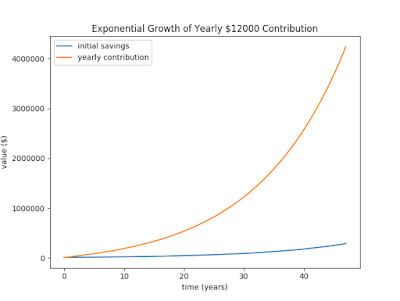
Whoa! After all of that time contributing to saving, we end up with over $4.2 million. That's some serious retirement funds. Now we're really starting to see the power of savings rates with regular contributions. It's not just important to save early, but to save regularly. However, this model is still relatively divorced from the real world. In the real world, we're never going to see a consistent 7% return year after year. Some years it will be less, and some years it will be a lot more. What happens to our plan of consistent yearly contributions when we know that some years we're going to be dropping in a chunk of cash right near the peak of the market?
To answer that question, we can look at historical prices. We used to be able to get a nice, long history of prices for the main market indexes—the Dow Jones, NASDAQ, and S&P500—quite easily from Yahoo and Google APIs, but it seems those sources have been shut down in the last couple years. We can still manually download .csv files of historical prices at finance.yahoo.com, for example the NASDAQ daily prices all the way back to its start in 1971 can be downloaded here. It's not as fun as using an API, but we can easily read this file into our Python script using Pandas read_csv() function, and offset the date so that we can look at years since the beginning of the index:
After the initial investment shares, we can populate a Series that matches the length of our investment period with updated shares as we make additional contributions each year. We loop through the historical prices, and each time we cross into a new year, we add more shares with the next contribution at the price that the index is at that time. Since the first day of trading in the new year doesn't necessarily land on January 2nd, the if condition shows a simple way to detect the first trading day of the new year for each year. Here's how our hypothetical investments did over the last 48 years sitting in the NASDAQ:

Yikes! Not only did we best the simple exponential model, but we blew it away with about $14M in savings by the end. The investments in the fund also never dropped below the conservative 7% estimated rate of return, even during the dotcom crash and the Great Recession. (Okay, it did a little in the beginning, but you can't really see that here.) Why did we do so much better? Partly it's because the NASDAQ has performed better than a 7% return, on average, getting about 9.5% returns over the last 48 years. That doesn't fully explain the better performance, though, because plugging the simple model with 9.5% returns would result in $9.7M by the time we retire.
The other $4.3M in gains comes from all of the contributions that happened while the market was down. This is by far the best time to buy because the market recovers more quickly after it's been down, and the gains of those new contributions are juiced along with the recovering shares that were purchased at higher prices. In the end, the gains are more than they would have been with a smooth rate of return. However, when the market is down, it's also the most difficult time to buy, and it's extremely hard (some say impossible) to predict the market. It's these characteristics that make it so important to stick to the plan of investing early and regularly.
We now have a more accurate hypothetical investment scenario, but we can do even better. So far we've assumed that we're investing the same amount every year. That's a fine goal, but it's going to get really easy to achieve as we get raises over the years. Hopefully we won't be making the same salary at 45 that we were at 25, so let's try to model that by building in a yearly increase to the contributions. Now, we have to make a few assumptions in light of a ton of potential contributing factors. Over the years expenses will likely increase as we buy a house, start a family, and generally start enjoying the fruits of our labor more. Be careful, though. If you find your expenses increasing faster than your salary, it's going to become more difficult to meet your savings goals.
Let's assume that's not the case, and you find a way to moderately increase your expenses over time. Most years it should be fairly straightforward to live on a budget pretty close to the previous year. Sometimes bigger expenses, or step-ups in spending happen, but step-ups in income also happen. Getting married or otherwise becoming a dual-income household is generally a big step-up. Promotions will also give a good boost to income. These positive things combined with a steady budget can result in most of the increased income being available for savings. Since savings is only a percentage of your total income, this means a big increase in savings. For example, suppose you're saving 20% of your income, and you get a 5% raise. If you sock all of that raise into savings, that equates to a 25% increase in savings. Since step-ups like that doesn't happen every year, let's keep things simple and assume a 5% increase in savings every year. That results in the following calculations:
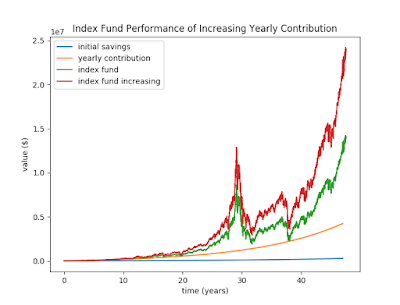
Now we're looking at about $24M available in retirement! This keeps getting better. Another nice thing about this investment is that it doesn't have to end at retirement. There are tons of options for taking out some funds to safely live off of and continue investing the rest, letting it grow further during retirement. Making donations to worthy causes is also a definite possibility here. You know, spread the wealth that you have been so blessed with. Of course, we have many, many years ahead of us before this nest egg becomes a reality, so let's focus on the model we're exploring. We can look at another inaccuracy that's been in the model for a while, namely that we're investing one big chunk of money each year. It should be better to invest smaller amounts more often, so let's split the yearly contribution into bimonthly paycheck contributions, 24 total for each year.

Huh, it's a little more difficult to see any difference with the paycheck contribution approach. This was actually a bit surprising because I expected more of an increase due to investing earlier and more frequently. To see how much of a difference there really is, we can plot the difference between the paycheck contributions and the yearly contributions:
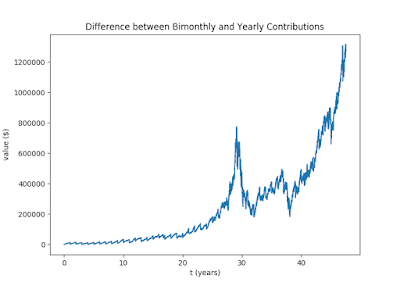
It turns out that we make an extra $1.3M over the full 48 years, but it takes some time to build up and is never more than about 5% of the total investment. The accumulation of exponential gains over the entire investment period is much more important than the small additional gains we get by spreading the yearly contributions over the course of each year. Even so, it's probably best to plug that money into the retirement fund as soon as it's available, just so that it'll be saved instead of spent. The small extra gains to be had from investing it a little bit earlier is a little extra bonus.
One thing we haven't modeled here is what happens if we could optimize our investment performance through buying and selling at opportune times, otherwise known as timing the market. This is a really bad idea for at least three reasons. First—and the most often cited reason—it's extremely difficult to time the market successfully, and do it consistently. The day-to-day movements in the market are so noisy that it's anyone's guess (and it really is a guess) which way the market is going to move at any given time. Even if you have a 50-50 shot of getting it right on any given trade, you're not going to get ahead at all by doing this. More likely, you'll fall behind because of the next reason.
Second, if you're selling a lot, it's probably short sales, and the taxes on those sales are going to erode your realized gains. That means you have to be doing that much better on your returns, just to break even with keeping your money parked in a fund. If the gains are going to be taxed at a marginal rate of 25%, and you're managing to make returns of 11%, then after taxes your gains are actually only 8.25%. That's less than the 9.5% average gains of the NASDAQ. You would actually need to get returns of 12.7% just to break even with leaving your money alone. As your investments grow, it gets even harder to beat the market because the larger gains push you into a higher tax bracket. At the 35% bracket you have to achieve gains of 14.6% just to break even. Granted, you could limit this market timing to tax-advantaged accounts, but that will become a smaller and smaller percentage of your total investments if you keep increasing your contributions. The smaller fraction of tax-advantaged funds will matter less and less over time. Plus, refer back to the first reason, or risk watching your tax-advantaged retirement accounts dwindle instead of grow.
Third, if you stick to index funds, as you should, you are limited in how soon you can sell after buying a fund. Depending on how you're investing, this limit can be 30 to 90 days from your last contribution. This limitation makes timing the market all the more difficult and fraught with risk. But that's a feature, not a bug. It discourages trying to do something you just shouldn't do. If you really want to try being a day trader, you're going to have to go with individual stocks, and that path carries its own set of bigger risks and an even bigger time commitment. Besides, look at those graphs of our investments. Nearly all of the downturns in the market were in the noise, save the dotcom crash and the Great Recession, and the latter doesn't even look like that big of a deal in the graph considering the recovery afterward. The bottom line is, you shouldn't sell. That is, unless you're ready to sell.
The one case where it's probably okay to sell early is if we've already overshot our long-term goals. Take a look back at the last graph. At the peak of the dotcom boom, before the bust, the model is showing investments of nearly $13.7M in the 29th year. If our goal was $10M or less by retirement, then it would be perfectly fine to sell off a significant amount of that position, pay the taxes on the long-term gains, and sink it into a more stable investment for safe-keeping. Or we may even decide to retire early! When the market crashes and the index fund is cheap again, we may even decide to get back in and benefit from the recovery. The point is that selling to get out of the market and then buying later to get back in had nothing to do with trying to predict the dotcom boom and bust. We were simply acting on the fact that our goals were met, and then we saw a prime opportunity that we couldn't pass up. Suffice it to say, these situations don't come up very often. In this 48-year span it only happened once, arguably twice with the housing crash, so it should not be a strategy to depend on happening frequently.
We've learned a great deal from this set of simple models. It's surprising how little code is needed to get a clear picture of some solid investment strategies. It's so obvious that it's great to start early and let the wonders of exponential growth work for you. Investing often—at least once a year—makes a huge difference in the value of your nest egg. Continuing to increase the contributions over time also maximizes your savings potential, and even adds significantly to the accumulated savings in later years. The best part is how easy it is to experiment once we have a working model. We can twiddle with the parameters and see how changes affect the outcome. Through that experimentation, we can get more comfortable with why certain recommendations make good sense, and better understand which investment strategy will help us reach our retirement goals with minimal fuss.
Disclaimer: I am not a financial adviser, so this article should not be taken as financial advice. It is merely an exploration of a model of retirement savings for the purpose of learning and understanding how savings could grow over time.
We'll start with a very simple model to get things started. How about we put in an initial investment of $12,000 at 20 years old and let it grow until retirement at 67. How do we have $12,000 at 20? Maybe it's a gift from a rich aunt and uncle or we saved like crazy during a summer internship between college semesters. Somehow we came up with it. Why $12,000? Because there's 12 months in a year, and that seemed nice. What does it look like after 48 years? Here's a simple exponential model to give us an estimate:
import pandas as pd
import numpy as np
import matplotlib.pyplot as plt

rate = 1.07
years_saving = 48
initial_savings = 12000
model = pd.DataFrame({'t': range(years_saving)})
model['simple_exp'] = [initial_savings*rate**year for year in model.t]

plt.figure()
plt.plot(model.t, model.simple_exp)
plt.title('Exponential Growth of Initial Savings')
plt.xlabel('time (years)')
plt.ylabel('value ($)')

Our little retirement fund reaches nearly $290,000 by the end of our career. That's not too bad considering it was just a single contribution from before we could legally drink, but it's probably not enough to last through retirement, what with inflation and health care and all to consider. What happens if we manage to pull together $12,000 every year and contribute to our nest egg? It's going to be tough in the beginning, but it'll get easier. Plus, those early years are the most important.
The equation for regular contributions to an exponentially growing investment is a little trickier, but other people have already figured it out so we'll just use what they did. The equation is
value = P*ry + C*(ry - 1)/(r - 1)
Where P is the principle investment, C is the yearly contribution, r is the rate of return in the form of 1.0x for x%, and y is the number of years to invest. Plugging that equation into our Python model gives the following code:
yearly_contribution = 12000
model['yearly_invest'] = model['simple_exp'] + [yearly_contribution*(rate**year - 1)/(rate-1) for year in model.t]
plt.plot(model.t, model.yearly_invest)
plt.title('Exponential Growth of Yearly $' + str(yearly_contribution) + ' Contribution')
plt.legend(['initial savings', 'yearly contribution'])

To answer that question, we can look at historical prices. We used to be able to get a nice, long history of prices for the main market indexes—the Dow Jones, NASDAQ, and S&P500—quite easily from Yahoo and Google APIs, but it seems those sources have been shut down in the last couple years. We can still manually download .csv files of historical prices at finance.yahoo.com, for example the NASDAQ daily prices all the way back to its start in 1971 can be downloaded here. It's not as fun as using an API, but we can easily read this file into our Python script using Pandas read_csv() function, and offset the date so that we can look at years since the beginning of the index:
ixic = pd.read_csv('ixic.csv')
ixic['Date'] = pd.to_datetime(ixic['Date'])
ixic['t'] = (ixic.Date - ixic.Date.min()) / np.timedelta64(1, 'Y')

shares = initial_savings / ixic.Close.iloc[0]
share_col = pd.Series(index=ixic.index)
for index, row in ixic.iterrows():
    if row.t >= round(row.t) and ixic.t.iloc[index-1] < round(row.t):
        shares += yearly_contribution / row.Close
    share_col.iloc[index] = shares
ixic['shares'] = share_col
plt.plot(ixic.t, ixic.Close*ixic.shares)
plt.title('Index Fund Performance of Yearly $' + str(yearly_contribution) + ' Contribution')
plt.legend(['initial savings', 'yearly contribution', 'index fund'])
After the initial investment shares, we can populate a Series that matches the length of our investment period with updated shares as we make additional contributions each year. We loop through the historical prices, and each time we cross into a new year, we add more shares with the next contribution at the price that the index is at that time. Since the first day of trading in the new year doesn't necessarily land on January 2nd, the if condition shows a simple way to detect the first trading day of the new year for each year. Here's how our hypothetical investments did over the last 48 years sitting in the NASDAQ:

Yikes! Not only did we best the simple exponential model, but we blew it away with about $14M in savings by the end. The investments in the fund also never dropped below the conservative 7% estimated rate of return, even during the dotcom crash and the Great Recession. (Okay, it did a little in the beginning, but you can't really see that here.) Why did we do so much better? Partly it's because the NASDAQ has performed better than a 7% return, on average, getting about 9.5% returns over the last 48 years. That doesn't fully explain the better performance, though, because plugging the simple model with 9.5% returns would result in $9.7M by the time we retire.
The other $4.3M in gains comes from all of the contributions that happened while the market was down. This is by far the best time to buy because the market recovers more quickly after it's been down, and the gains of those new contributions are juiced along with the recovering shares that were purchased at higher prices. In the end, the gains are more than they would have been with a smooth rate of return. However, when the market is down, it's also the most difficult time to buy, and it's extremely hard (some say impossible) to predict the market. It's these characteristics that make it so important to stick to the plan of investing early and regularly.
We now have a more accurate hypothetical investment scenario, but we can do even better. So far we've assumed that we're investing the same amount every year. That's a fine goal, but it's going to get really easy to achieve as we get raises over the years. Hopefully we won't be making the same salary at 45 that we were at 25, so let's try to model that by building in a yearly increase to the contributions. Now, we have to make a few assumptions in light of a ton of potential contributing factors. Over the years expenses will likely increase as we buy a house, start a family, and generally start enjoying the fruits of our labor more. Be careful, though. If you find your expenses increasing faster than your salary, it's going to become more difficult to meet your savings goals.
Let's assume that's not the case, and you find a way to moderately increase your expenses over time. Most years it should be fairly straightforward to live on a budget pretty close to the previous year. Sometimes bigger expenses, or step-ups in spending happen, but step-ups in income also happen. Getting married or otherwise becoming a dual-income household is generally a big step-up. Promotions will also give a good boost to income. These positive things combined with a steady budget can result in most of the increased income being available for savings. Since savings is only a percentage of your total income, this means a big increase in savings. For example, suppose you're saving 20% of your income, and you get a 5% raise. If you sock all of that raise into savings, that equates to a 25% increase in savings. Since step-ups like that doesn't happen every year, let's keep things simple and assume a 5% increase in savings every year. That results in the following calculations:
shares = initial_savings / ixic.Close.iloc[0]
share_col = pd.Series(index=ixic.index)
for index, row in ixic.iterrows():
    if row.t >= round(row.t) and ixic.t.iloc[index-1] < round(row.t):
        shares += yearly_contribution / row.Close
        yearly_contribution *= 1.05
    share_col.iloc[index] = shares
ixic['shares_inc'] = share_col
plt.plot(ixic.t, ixic.Close*ixic.shares_inc)
plt.title('Index Fund Performance of Increasing Yearly Contribution')
plt.legend(['initial savings', 'yearly contribution', 'index fund', 'index fund increasing'])

Now we're looking at about $24M available in retirement! This keeps getting better. Another nice thing about this investment is that it doesn't have to end at retirement. There are tons of options for taking out some funds to safely live off of and continue investing the rest, letting it grow further during retirement. Making donations to worthy causes is also a definite possibility here. You know, spread the wealth that you have been so blessed with. Of course, we have many, many years ahead of us before this nest egg becomes a reality, so let's focus on the model we're exploring. We can look at another inaccuracy that's been in the model for a while, namely that we're investing one big chunk of money each year. It should be better to invest smaller amounts more often, so let's split the yearly contribution into bimonthly paycheck contributions, 24 total for each year.
payday_contribution = 500
shares = initial_savings / ixic.Close.iloc[0]
share_col = pd.Series(index=ixic.index)
prev_day = ixic.Date.iloc[0].day
for index, row in ixic.iterrows():
    today = ixic.Date.iloc[index-1].day
    if prev_day > 15 and today < 10 or prev_day < 15 and today >= 15:
        shares += payday_contribution / row.Close
    if row.t >= round(row.t) and ixic.t.iloc[index-1] < round(row.t):
        payday_contribution *= 1.05
    share_col.iloc[index] = shares
    prev_day = today
ixic['shares_inc_payday'] = share_col
plt.plot(ixic.t, ixic.Close*ixic.shares_inc_payday)
plt.title('Index Fund Performance of Increasing Paycheck Contribution')
plt.legend(['initial savings', 'yearly contribution', 'index fund', 'index fund increasing', 'index fund payday'])

Huh, it's a little more difficult to see any difference with the paycheck contribution approach. This was actually a bit surprising because I expected more of an increase due to investing earlier and more frequently. To see how much of a difference there really is, we can plot the difference between the paycheck contributions and the yearly contributions:

One thing we haven't modeled here is what happens if we could optimize our investment performance through buying and selling at opportune times, otherwise known as timing the market. This is a really bad idea for at least three reasons. First—and the most often cited reason—it's extremely difficult to time the market successfully, and do it consistently. The day-to-day movements in the market are so noisy that it's anyone's guess (and it really is a guess) which way the market is going to move at any given time. Even if you have a 50-50 shot of getting it right on any given trade, you're not going to get ahead at all by doing this. More likely, you'll fall behind because of the next reason.
Second, if you're selling a lot, it's probably short sales, and the taxes on those sales are going to erode your realized gains. That means you have to be doing that much better on your returns, just to break even with keeping your money parked in a fund. If the gains are going to be taxed at a marginal rate of 25%, and you're managing to make returns of 11%, then after taxes your gains are actually only 8.25%. That's less than the 9.5% average gains of the NASDAQ. You would actually need to get returns of 12.7% just to break even with leaving your money alone. As your investments grow, it gets even harder to beat the market because the larger gains push you into a higher tax bracket. At the 35% bracket you have to achieve gains of 14.6% just to break even. Granted, you could limit this market timing to tax-advantaged accounts, but that will become a smaller and smaller percentage of your total investments if you keep increasing your contributions. The smaller fraction of tax-advantaged funds will matter less and less over time. Plus, refer back to the first reason, or risk watching your tax-advantaged retirement accounts dwindle instead of grow.
Third, if you stick to index funds, as you should, you are limited in how soon you can sell after buying a fund. Depending on how you're investing, this limit can be 30 to 90 days from your last contribution. This limitation makes timing the market all the more difficult and fraught with risk. But that's a feature, not a bug. It discourages trying to do something you just shouldn't do. If you really want to try being a day trader, you're going to have to go with individual stocks, and that path carries its own set of bigger risks and an even bigger time commitment. Besides, look at those graphs of our investments. Nearly all of the downturns in the market were in the noise, save the dotcom crash and the Great Recession, and the latter doesn't even look like that big of a deal in the graph considering the recovery afterward. The bottom line is, you shouldn't sell. That is, unless you're ready to sell.
The one case where it's probably okay to sell early is if we've already overshot our long-term goals. Take a look back at the last graph. At the peak of the dotcom boom, before the bust, the model is showing investments of nearly $13.7M in the 29th year. If our goal was $10M or less by retirement, then it would be perfectly fine to sell off a significant amount of that position, pay the taxes on the long-term gains, and sink it into a more stable investment for safe-keeping. Or we may even decide to retire early! When the market crashes and the index fund is cheap again, we may even decide to get back in and benefit from the recovery. The point is that selling to get out of the market and then buying later to get back in had nothing to do with trying to predict the dotcom boom and bust. We were simply acting on the fact that our goals were met, and then we saw a prime opportunity that we couldn't pass up. Suffice it to say, these situations don't come up very often. In this 48-year span it only happened once, arguably twice with the housing crash, so it should not be a strategy to depend on happening frequently.
We've learned a great deal from this set of simple models. It's surprising how little code is needed to get a clear picture of some solid investment strategies. It's so obvious that it's great to start early and let the wonders of exponential growth work for you. Investing often—at least once a year—makes a huge difference in the value of your nest egg. Continuing to increase the contributions over time also maximizes your savings potential, and even adds significantly to the accumulated savings in later years. The best part is how easy it is to experiment once we have a working model. We can twiddle with the parameters and see how changes affect the outcome. Through that experimentation, we can get more comfortable with why certain recommendations make good sense, and better understand which investment strategy will help us reach our retirement goals with minimal fuss.
Ep 26: Big Fun With Little Figures Is Live!
Ep 26: Big Fun with Little Figures
I talk with Howard Whitehouse about Mad Dogs With Guns, his gangster game from Osprey Games. In a separate segment, I talk with Peter Berry of Baccus 6mm to talk about the seeming monopoly of 28mm figures and games in the glossy gaming magazines.
https://soundcloud.com/user-989538417/episode-26-big-fun-with-little-figures
The Veteran Wargamer is brought to you by Kings Hobbies and Games
http://www.Kingshobbiesandgames.com
https://www.facebook.com/Special-Artizan-Service-Miniatures-1791793644366746/
Join the conversation at https://theveteranwargamer.blogspot.com, email theveteranwargamer@gmail.com, Twitter @veteranwargamer
Segment 1
Follow Howard on Facebook
https://www.facebook.com/Howard.Whitehouse.Writer/?ref=br_rs
https://www.facebook.com/Pulp-Action-Library-283960595046814/
Buy Mad Dogs With Guns:
Mad Dogs With Guns - Howard Whitehouse https://ospreypublishing.com/mad-dogs-with-guns
Pulp Action Library - http://www.pulpactionlibrary.com/
Other companies we mentioned:
Copplestone Castings http://www.copplestonecastings.co.uk/list.php?cat=7
Pulp Figures https://pulpfigures.com/products/category/11
Brigade Games http://brigadegames.3dcartstores.com/
Paddy Whacked - T.J. English https://www.amazon.com/Paddy-Whacked-Untold-American-Gangster/dp/0060590033
The Outfit - Gus Russo https://www.amazon.com/Outfit-Gus-Russo/dp/1582342792/
True Detective - Nathan Heller Series - Max Allen Collins https://www.amazon.com/True-Detective-Nathan-Heller-Novels/
Segment 2
Follow Baccus6mm on Facebook - https://www.facebook.com/Baccus6mm/
Joy of Six - https://www.facebook.com/TheJoyofSix/
Peter's Opinion piece - https://www.baccus6mm.com/news/20-09-2017/Historicalgaming-'Thetimestheyareachanging'/
Other companies we mentioned:
Warlord - https://us-store.warlordgames.com/
Perry Miniatures - https://www.perry-miniatures.com/
Games Workshop - https://www.games-workshop.com/en-US/Home
Wargames, Soldiers and Strategy - https://www.karwansaraypublishers.com/wss-mag
Music courtesy bensound.com. Recorded with zencastr.com. Edited with Audacity. Make your town beautiful; get a haircut.
I talk with Howard Whitehouse about Mad Dogs With Guns, his gangster game from Osprey Games. In a separate segment, I talk with Peter Berry of Baccus 6mm to talk about the seeming monopoly of 28mm figures and games in the glossy gaming magazines.
https://soundcloud.com/user-989538417/episode-26-big-fun-with-little-figures
The Veteran Wargamer is brought to you by Kings Hobbies and Games
http://www.Kingshobbiesandgames.com
https://www.facebook.com/Special-Artizan-Service-Miniatures-1791793644366746/
Join the conversation at https://theveteranwargamer.blogspot.com, email theveteranwargamer@gmail.com, Twitter @veteranwargamer
Segment 1
Follow Howard on Facebook
https://www.facebook.com/Howard.Whitehouse.Writer/?ref=br_rs
https://www.facebook.com/Pulp-Action-Library-283960595046814/
Buy Mad Dogs With Guns:
Mad Dogs With Guns - Howard Whitehouse https://ospreypublishing.com/mad-dogs-with-guns
Pulp Action Library - http://www.pulpactionlibrary.com/
Other companies we mentioned:
Copplestone Castings http://www.copplestonecastings.co.uk/list.php?cat=7
Pulp Figures https://pulpfigures.com/products/category/11
Brigade Games http://brigadegames.3dcartstores.com/
Paddy Whacked - T.J. English https://www.amazon.com/Paddy-Whacked-Untold-American-Gangster/dp/0060590033
The Outfit - Gus Russo https://www.amazon.com/Outfit-Gus-Russo/dp/1582342792/
True Detective - Nathan Heller Series - Max Allen Collins https://www.amazon.com/True-Detective-Nathan-Heller-Novels/
Segment 2
Follow Baccus6mm on Facebook - https://www.facebook.com/Baccus6mm/
Joy of Six - https://www.facebook.com/TheJoyofSix/
Peter's Opinion piece - https://www.baccus6mm.com/news/20-09-2017/Historicalgaming-'Thetimestheyareachanging'/
Other companies we mentioned:
Warlord - https://us-store.warlordgames.com/
Perry Miniatures - https://www.perry-miniatures.com/
Games Workshop - https://www.games-workshop.com/en-US/Home
Wargames, Soldiers and Strategy - https://www.karwansaraypublishers.com/wss-mag
Music courtesy bensound.com. Recorded with zencastr.com. Edited with Audacity. Make your town beautiful; get a haircut.
Mini Militia MOD Apk – Pro Pack, Unlimited Ammo, Ulimited Health

Doodle Army 2: Mini Militia MOD is a free-to-play 2D shooter game released for iOS and Android devices. Maximize your fun by adding some Mini Militia MODs to your game! Like Unlimited Health, Unlimited bullets, Unlimited Flying, One shot kill, the etc.this game is everyone favorite so why not to combine all the mods available for it into one and share with you guys this is what we did today so without wasting time lets get started
Mini-Militia is so popular nowadays! It is simple & easy to play. But what about adding a bit more fun by using Mini Militia MOD APK & Mini Militia Cheats! I've researched a lot & finally collected 3 Mini Militia Latest MOD APK for Android! Direct Download via Google Drive Links!
Disclaimer: All the mods and hacks are just for trial purpose. This is only to show the hidden features of the mini-militia. If you like the features, then you can purchase the pro pack and enjoy playing the features legally. While the mini militia health hack is not there, but you can increase the capacity of health. If you can purchase then cooperate with developers and purchase it. We are not responsible for any disruption. File Links shared here are total responsibility for their hosted site.

Mini-Militia MOD Apk:
NOTE: All MODs here are for educational and trial purposes only! And never use it for your advantage. It's just for fun.Mini Militia MOD APK Pro Pack Latest Version:
It is for those who don't want to use mini militia hacks but want to get access to all weapons to win more! This Mini Militia MOD APK 2018 latest version is best for fair play.
Features:
- Pro Pack Unlocked Free
- Latest Version 4.0.36 MOD APK
- Pre-added Points in the shop
2. Mini-Militia MOD APK Unlimited Ammo and Nitro
It has some basic cheats/hacks. It has pro pack, unlimited flying, ammo without reload and Unlimited x7 Zoom for any gun! Mini Militia MOD shd is suitable for those who don't want to show that they are cheating or using Mini Milita MOD app 2018.
Features:
- Pro Pack Unlocked Free
- Unlimited Flying/Nitro
- Unlimited Ammo/bullets
- No reload
- Spawn with New Heavy Gun
- 7x Zoom on any gun
3. Mini Militia ALL MOD APK – MEGA MOD!
It has Mini Militia all MODs such as free pro pack, unlimited health, unlimited nitro, unlimited ammo, unlimited flying & Mini Militia one shot kill hack. Fully Hacked Mini Militia APK. Mini Militia Unlimited All MOD Everything unlocked & no dying! You'll not die in this GOD MOD. Including Mini Militia two gunsFEATURES:
- Unlimited Health
- Unlimited Ammo
- Unlimited Flying/Nitro
- Unlimited Points
- One shot kill
- Multiple bullets per shot
- No reload
- Custom Avatar
- Two Guns at once
4. MEGA MOD v3.0.87 (No Infinite Health)
MOD Features- Unlimites Ammo
- Unlimited Flying
- Unlimited Battle Points
- One Shot Kill
- Pro Pack Unlocked

5.Doodle army 2 MEGA MOD: Pro
MOD Features:- Pro Pack Unlocked
- Unlimited Health Unlimited Ammo
- Unlimited Flying
- Red Aim for Better Accuracy
- Anti-Ban
6. Ultra MOD Pack! (with Invisible Avatar)
MOD Features:- Unlimited Nitro
- Unlimited Ammo
- Health One Shot Kill
- Invisible Avatar
- Pro Pack Activated Already
- Dual Weild Any Gun
So, That's it guys! I hope you will like these MODs! Don't forget to Share this Post with your friends to help them out to get the Unlimited Fun!
AdSense Now Understands Telugu
Today, we're excited to announce the addition of Telugu, a language spoken by over 70 million in India and many other countries around the world, to the family of AdSense supported languages. With this launch, publishers can now monetize their Telugu content and advertisers can connect to a Telugu speaking audience with relevant ads.
To start monetizing your Telugu content website with Google AdSense:
Check the AdSense program policies and make sure your website is compliant.
Sign up for an AdSense account.
Add the AdSense code to start displaying relevant ads to your users.
Welcome to AdSense! Sign up now.
Posted by:
The AdSense Internationalization Team


To start monetizing your Telugu content website with Google AdSense:
Check the AdSense program policies and make sure your website is compliant.
Sign up for an AdSense account.
Add the AdSense code to start displaying relevant ads to your users.
Welcome to AdSense! Sign up now.
Posted by:
The AdSense Internationalization Team
Subscribe to:
Posts (Atom)